


AIoT SenseNode - Next Generation IoT Platform
AIoT SenseNode - Next Generation IoT Platform
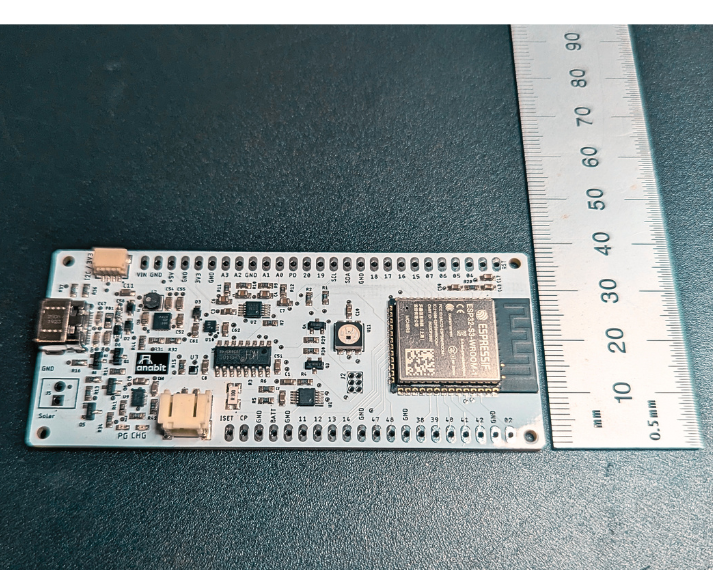
Anabit's AIoT SenseNode is an open-source edge computing platform designed for next-generation IoT applications. It combines wireless connectivity, precision analog measurement, comprehensive battery management, and flexible power options into a single compact module. Powered by a single-cell lithium-ion battery, USB-C, or a solar panel, the AIoT SenseNode is equally suited for portable, remote, and permanently installed systems. Its high-accuracy analog front end, support for multiple digital interfaces, and detailed battery health monitoring make it easy to connect sensors, control actuators, and build intelligent IoT, AIoT, and IIoT solutions.
The SenseNode's wireless and computing capabilities are enabled by the ESP32-S3 platform. The ESP32-S3 features a dual-core processor that supports vector instructions to accelerate neural network computing. The ESP32-S3 on the SenseNode is compatible with ESP-CLAW, which is an edge AI agent frame work. For wireless communication the ESP32-S3 features Wi-Fi, Bluetooth Classic + BLE, and the ESP-NOW protocol for creating small low power mesh networks.
The ESP32 does many things well, but one thing it does not do well is ADC measurements. The onboard 12 bit ADC in the ESP32 delivers very poor measurement accuracy. To address this the AIoT SenseNode employs a low power ΔΣ 12-bit ADC IC that features 4 single ended or 2 differential measurement channels. The SenseNode also features comprehensive battery measurement capabilities. It can make high accuracy battery current (charge and discharge), voltage, and power measurements. These measurements give you an onboard fuel gauge to monitor the state of charge of any lithium ion or polymer single cell battery.
The AIoT SenseNode features flexible power options so it can be used anywhere. The SenseNode can be powered from its USB-C connector or from a single cell battery. The USB-C connector powers the design as well as charges the Lithium Ion or polymer battery. The SenseNode also has a second input power source for charging the battery. This flexible charging port can support power sources such as a solar panel or inductive charging pad.
Product features
Product features
AIoT SenseNode Flexible Power:
--> Can be powered by USB-C connection or single cell Lithium Ion or Polymer battery
--> Onboard charging and battery monitoring circuits
--> There is a second charging port (max 7V) for battery charging power sources such as solar panel, inductor charging, or general DC source
--> Automatic power switching / isolation so all power sources can be connected. When USB-C is connected it is used a primary power source and battery charging source
--> Design consists of 5V and 3.3V power rail that can be accessed via external circuits
AIoT SenseNode Measurement Capabilities:
--> External high accuracy Sigma Delta 12-bit ADC, that consists of 4 single ended or 2 differential measurement channels
--> The ADC has an input programmable gain amp that allows the user to adjust the voltage measurement range to maximize measurement resolution
--> The ADC interfaces with the ESP32 via I2C communication
--> A battery monitoring IC allows tracking of battery current (charge and discharge), battery voltage, and battery power.
--> The battery monitoring circuit can serve as a fuel gauge, allowing you to monitor the battery's state of charge, charge rate, and discharge rate
--> The battery monitoring circuit interfaces with the ESP32-S3 via I2C communication
Summary of ESP32-S3 Features:
--> Xtensa® 32-bit LX7 dual-core processor that operates at up to 240 MHz
--> 2.4 GHz Wi-Fi (802.11 b/g/n), Bluetooth Classic + BLE 5.4, and the ESP-NOW protocol for creating small low power mesh networks
--> MCU supports vector instructions, which provides acceleration for neural network computing and signal processing workloads. Compatible with ESP-CLAW edge AI agent framework
--> Peripherals: GPIOs, SPI, I2S, I2C, PWM, RMT, ADC, DAC and UART, SD/MMC host and TWAI™
--> Deep and light sleep low power modes with real time clock (RTC) timing control
Link for ESPRESSIF's ESP32-S3 product page: https://www.espressif.com/en/products/socs/esp32-s3/
Communication, programming, and other features:
--> USB C interface supports UART communication with the ESP32 as well programming the ESP32-S3 with just a USB cable
--> 6 pin interface can connect to the ESP-Prog for programming and debugging the ESP32-S3
--> Includes a QWIIC connector with 3.3V power and I2C communication to easily interface with Sparkfun and Adafruit sensor boards
--> Onboard RGB LED that interfaces with the ESP32-S3
--> Power down pin, when actively pulled low all power buses are turn off
See the AIoT SenseNode getting started page for a detailed descriptions on pins and features.
Specifications
Specifications
12-bit ΔΣ low power ADC (PN: ADS1015L):
- 4x single ended channels or 2x differential channels
- 3300 maximum sample rate
- Measure range settings: ±0.256V, ±0.512V, ±1.024V, ±2.048V, ±3.3V
- I2C address 1001 000b
Battery management and monitoring
- Peak battery charge current 400mA
- Max voltage of screw terminal charge port 7V
- Current is measured across a 30mOhm high side shunt resistor, bidirectional current measurements
- Battery connector: JST 2mm male
- Charge status pin interfaces with ESP32: low = charging and high Z = not charging
- INA226A measurement IC I2C address: 1000 100b
Power characteristics and specifications:
- Max current from USB-C or Vin pin with battery charging: 800mA
- Max current no battery charging: 400mA
- Max combined current draw from 5V and 3.3V buses: 150mA
- Nominal current with ESP32 in sleep mode: 2.0mA
- Nominal current power down state (PD pulled low): 16mA
For detailed specifications on the ESP32-S3 refer to its product page: https://www.espressif.com/en/products/socs/esp32-s3/
Bulk Pricing and Discount Information
Bulk Pricing and Discount Information
Discount for large orders
5% discount for quantities of 10 or above, automatically applied at checkout. Contact Anabit for bulk pricing on quantities of 50 or more.


Resources
-
Tutorials
Explore tutorials and getting started guides to get the most out of your product.
How to Measure Wind Speed from a Pulsed Output Anemometer with a Microcontroller
-
Open-Source Downloads
Download open source hardware files, including PCB design files and schematic files
Download -
Forum & Discussion
Have product questions or need technical support? Have general questions or insights to share related to data converters? Join the Anabit forum!
Anabit Forum